
Ayurvedic Medicinal Plants
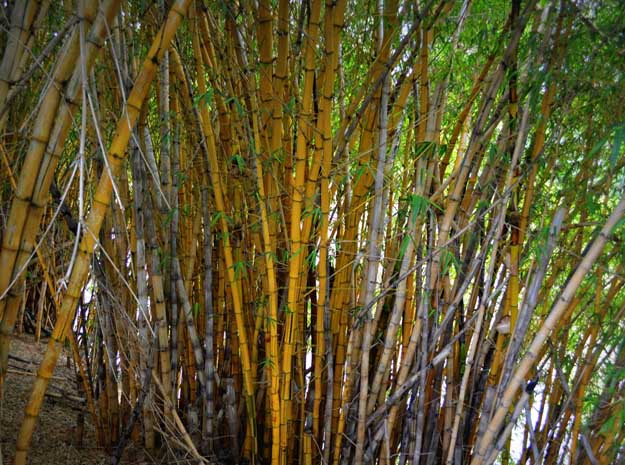
Bambusa vulgaris
Genus: Bambusa
Botanical name: Bambusa vulgaris
PLANT NAME IN DIFFERENT LANGUAGES
Sanskrit: vambhah, vamsh
Hindi: Baans, Bambu, Buns
English: Golden Bamboo, Buddha’s Belly Bamboo
Malayalam: Manjamula
MEDICINAL PROPERTIES
Golden Bamboo forms moderately loose clumps and has no thorns. It has lemon-yellow culms (stems) with green stripes and dark green leaves. Stems are not straight, not easy to split, inflexible, thick-walled, and initially strong. The densely tufted culms grow 10–20 metres (30–70 ft) high and 4–10 centimetres (2–4 in) thick. Culms are basally straight or flexuose (bent alternately in different directions), drooping at the tips. Culm walls are slightly thick. Nodes are slightly inflated. Internodes are 20–45 centimetres (7.9–17.7 in). Several branches develop from mid-culm nodes and above. Culm leaves are deciduous with dense pubescence. Leaf blades are narrowly lanceolate.
The leaves are considered cooling, and their decoction is given in fevers, cough and sore throat. A paste of the leaves is used for treating burns and wounds. The chloroform extract of leaves was found to be active against Mycobacterium tuberculosis.