
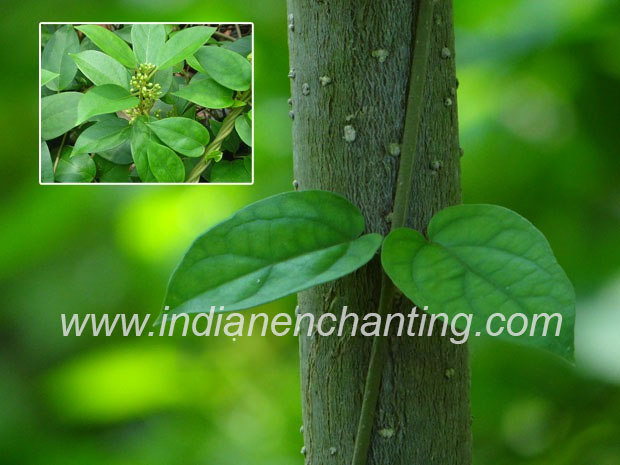
Chakkarakkolli ചക്കരക്കൊല്ലി
Genus: Gymnema
Botanical name: Gymnema sylvestre (Retz.)
PLANT NAME IN DIFFERENT LANGUAGES
Sanskrit: Ajasringi, Meshasringi, Madhunasini, ajaballi, ajaghandini
Hindi: Gud-mar, Merasingi, Chhota-dudhilata, Gudmar, Gurmar, Medhashingi
English: Periploca of the woods.
Malayalam: Chakkarakkolli, Madhunasini
MEDICINAL PROPERTIES
Chakkarakkolli is a famed plant, revered for its use in treatment of diabetes for nearly two millennia. The Hindi name Gurmar actually means diabetes killer. It is a large climber, rooting at nodes. Leaves are elliptic, narrow tipped, base narrow. Leaves are smooth above, and sparsely or densely velvety beneath. Pale yellow flowers are small, in auxiliary and lateral umbel like cymes. Stalk of the umbel is long. Sepals are long, ovate, obtuse, velvety. Flowers are pale yellow, bell-shaped. Corona is single, with 5 fleshy scales.
While it is still being studied, and the effects of the herb are not entirely known. Periploca of the woods reduces the taste of sugar when it is placed in the mouth. From extract of the leaves were isolated glycosides known as gymnemic acids, which exhibit anti-sweet activity. This effect lasts up to about 2 hours. Some postulate that the herb may block sugar receptors on the tongue. This effect was observed in isolated rat neurons.
Historically, the leaves were used for stomach ailments, constipation, water retention, and liver disease, however, these claims are not supported by scientific studies.