
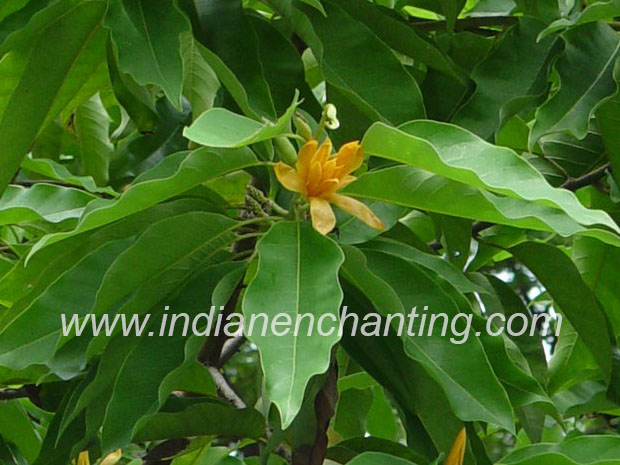
Campakam ചമ്പകം
Genus: Magnolia
Botanical name: Magnolia champaca
PLANT NAME IN DIFFERENT LANGUAGES
Sanskrit: Champakah
Hindi: Champa
English: Champak, Joy Perfume Tree
Malayalam: Campakam
MEDICINAL PROPERTIES
A tall handsome evergreen tree, up to 30 m in height and 50-80 cm in diameter with straight stem and smooth grey or brown bark; leaves simple, alternate oblong-lanceolate or lanceolate, subcoriaceous, entire, glabrous above; flowers yellowish to orange, very fragrant, solitary and axillary; fruits 5-10 cm long, ovoid or ellipsoid capsules, dark brown opening on the back by two valves, valves woody, covered with white warty excrescences, seeds 1-12, brown, rounded on the back with pink fleshy aril.
The root and root bark are purgative and emmenagogue and are useful in the treatment of abscesses, inflammation, constipation amenorrhoea and dysmenorrhoea. The stem bark is astringent, febrifuge, diuretic, stimulant and expectorant and useful in chronic gastritis, fever, strangyry, cough, bronchitis and cardiac debility. Flowers, flower buds and fruits are bitter, astringent, acrid, refrigerant, haemostatic, digestive, carminative, depurative, valnerary, anthelmintic, diuretic, diaphoretic, expectorant, emmenagogue, cardiotonic, stimulant, antispasmodic and stomachic. They are useful in dyspepsia, nausea, vitiated conditions of pitta, vatta, burning sensation, haemoptysis, pruritus, skin diseases, leprosy, wounds, cough, bronchitis, malarial fever, and general debility. The seeds and fruits are useful in the treatment of psoriasis plantaris.