
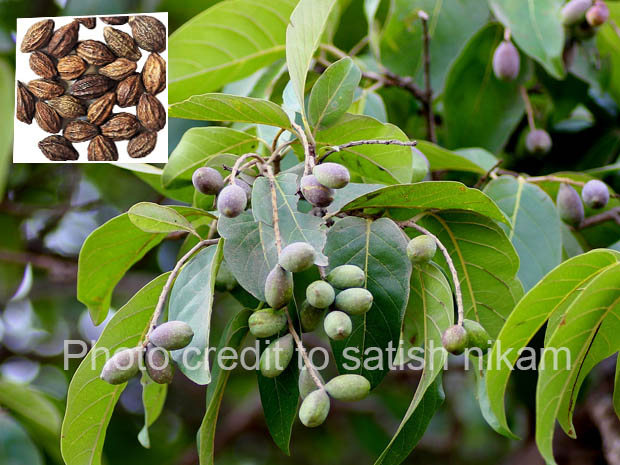
Chebulic myrobalan
Genus: Terminalia
Botanical name: Terminalia chebula Retz
PLANT NAME IN DIFFERENT LANGUAGES
Sanskrit: Chetaki, Haritaki, Abhaya, Pathya, Rohinee
English: Chebulic myrobalan
Hindi: Harad
Malayalam: Kadukka
MEDICINAL PROPERTIES
Chebulic myrobalan is a deciduous tree growing to 30-metre (98 ft) tall, with a trunk up to 1-metre (3 ft 3 in) in diameter. The leaves are alternate to subopposite in arrangement, oval, 7–8-centimetre (2.8–3.1 in) long and 4.5–10-centimetre (1.8–3.9 in) broad with a 1–3-centimetre (0.39–1.2 in) petiole. The fruit isdrupe-like, 2–4.5-centimetre (0.79–1.8 in) long and 1.2–2.5-centimetre (0.47–0.98 in) broad, blackish, with five longitudinal ridges
This tree yields smallish, ribbed and nut-like fruits which are picked when still green and then pickled, boiled with a little added sugar in their own syrupor used in preserves; this preserve is called ‘Hareer Ka Murabba in Urdu language. The seed of the fruit, which has an elliptical shape, is an abrasive seed enveloped by a fleshy and firm pulp. It is regarded as a universal panacea in the Ayur-Vedic Medicine and in the Traditional Tibetan medicine. It is reputed to cure blindness and it is believed to inhibit the growth of malignant tumours.
Chebulic myrobalan is used to purify the blood from the poison of viper.