
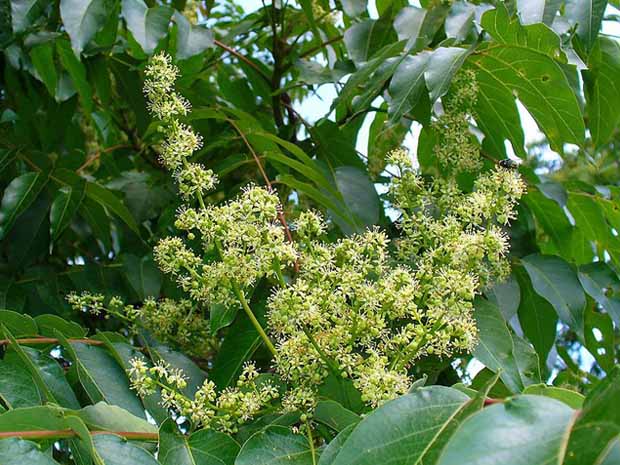
Ailanthus excelsa
Genus: Ailanthus
Botanical name: Ailanthus excelsa
PLANT NAME IN DIFFERENT LANGUAGES
Sanskrit: Mahanimba, Deerkhavrinda, Arala, Pootivriksha, Khodakaranja
Hindi: Atu, Arlu, Artu
English: Indian Tree of Heaven, Coramandel ailanto
Malayalam: Mattippalmaram, Matti, Pongalyam, Mattipongilyam, Peru, Mattipalmaram

MEDICINAL PROPERTIES
Indian Tree of Heaven is a large deciduous tree, 18-25 m tall; trunk straight, 60-80 cm in diameter; bark light grey and smooth, becoming grey-brown and rough on large trees, aromatic, slightly bitter. Leaves alternate, pinnately compound, large, 30-60 cm or more in length; leaflets 8-14 or more pairs, long stalked, ovate or broadly lance shaped from very unequal base, 6-10 cm long, 3-5 cm wide, often curved, long pointed, hairy gland; edges coarsely toothed and often lobed. Flower clusters droop at leaf bases, shorter than leaves, much branched; flowers many, mostly male and female on different trees, short stalked, greenish-yellow. Five sepals, 5 narrow petals spreading 6 mm across. Fruit a 1-seeded samara, lance shaped, flat, pointed at ends, 5 cm long, 1 cm wide, copper red, strongly veined, twisted at the base The genus name Ailanthus comes from ailanthos (tree of heaven), the Indonesian name for Indian Tree of Heaven.
The bark of Indian Tree of Heaven is used for dysentery, worm infestations, asthma, bronchitis, cold, colic pain, skin diseases, gynecological diseases and fever.