
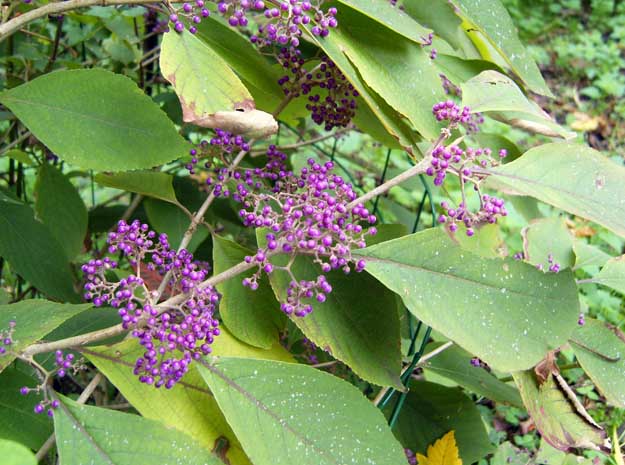
Callicarpa tomentosa
Genus: Callicarpa
Botanical name: Callicarpa tomentosa
PLANT NAME IN DIFFERENT LANGUAGES
Sanskrit: Priyangu, Phalini
Hindi: Priyangu, Daiya
English: Velvety Beauty Berry, American beautyberry
Malayalam: Naayththeekk, Njazhal poo, Njazhal
MEDICINAL PROPERTIES
Velvety Beauty Berry is a large shrub or small tree about 5 m tall. Bark grey, smooth. Branchlets are quadrangular, densely velvety. Leaves are simple, opposite, carried on stalks 2.5-7.5 cm long, densely white velvety. Leaf blade is 10.5-25 x 5.5-15 cm, elliptic to broadly elliptic or ovate, tip pointed to long-pointed, base narrow, thinly leathery, glaucous, densely white velvety beneath. Secondary nerves and reticulation are impressed above, midrib raised above. Secondary nerves are 6-9 pairs. Inflorescence consists of branched cymes in leaf axils. Flowers are purple, stalkless. Fruit is a round drupe, black, shining, 4 pyrenes; seeds 3-4. Velvety Beauty Berry is found in open disturbed evergreen to semi-evergreen forests in Peninsular India and Sri Lanka, and throughout Western Ghats, up to 1400 m.
The Flowers and Fruits of Velvety Beauty Berry is used for diarrhea, arthritis, burning sensation, ulcers, poisonous bites and blackish discoloration on face.
Velvety Beauty Berry has been used as a folk remedy to prevent mosquito bites. Four chemicals isolated from Callicarpa have been shown to act as insect repellents: borneol, callicarpenal, intermedeol, and spathulenol. The use of callicarpenal has been patented by the United States Department of Agriculture’s Agriculture Research Service as a mosquito repellen