
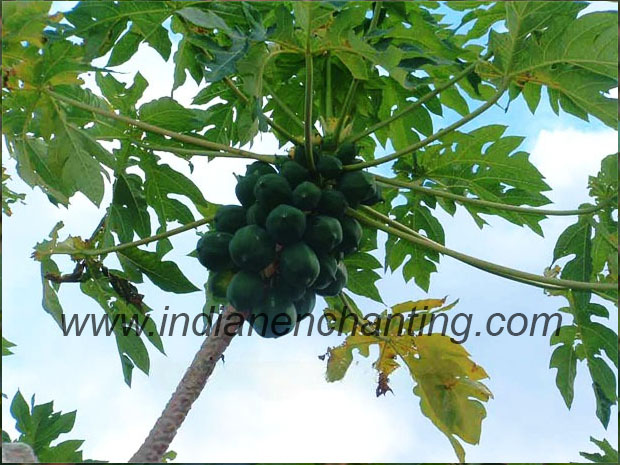
Carica papaya Linn
Botanical name: Carica papaya Linn.
PLANT NAME IN DIFFERENT LANGUAGES
Sanskrit: Erandakarkati, Brehmerandav
English : Papaya
Hindi : Pappaya, Pappita
Malayalam : Kappalam
MEDICINAL PROPERTIES
The papaya is a large, tree-like plant, with a single stem growing from 5 to 10 m (16 to 33 ft) tall, with spirally arranged leaves confined to the top of the trunk. The lower trunk is conspicuously scarred where leaves and fruit were borne. The leaves are large, 50–70 cm (20–28 in) in diameter, deeply palmately lobed, with seven lobes. Unusually for such large plants, the trees are dioecious. The tree is usually unbranched, unless lopped. The flowers are similar in shape to the flowers of the Plumeria, but are much smaller and wax-like. They appear on the axils of the leaves, maturing into large fruit – 15–45 cm (5.9–18 in) long and 10–30 cm (3.9–12 in) in diameter. The fruit is ripe when it feels soft (as soft as a ripe avocado or a bit softer) and its skin has attained an amber to orange hue.
Papaya is marketed in tablet form to remedy digestive problems. Women in India, Bangladesh, Pakistan, Sri Lanka, and other countries have long used green papaya as an herbal medicine for contraception and abortion. Enslaved women in the West Indies were noted for consuming papaya to prevent pregnancies and thus preventing their children from being born into slavery.
Papaya helps to increase the platelets in the body of the victims of snakebite.