
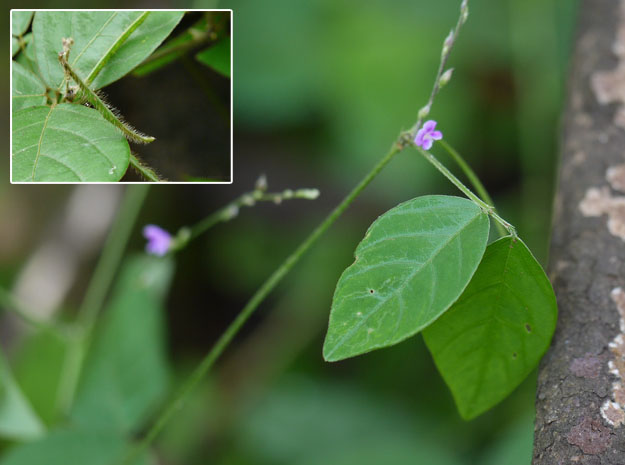
Blue Wiss
Genus: Teramnus
Botanical name: Teramnus labialis
PLANT NAME IN DIFFERENT LANGUAGES
Sanskrit: Hayahapuchchi, Kalyani, Mashaparni, Visarini
Hindi: Kalyan, Lomashparnini
English: Blue Wiss, Rabbit vine, Horse vine, Wlid black gram
Malayalam: Kattuzunu, kattulunnu
MEDICINAL PROPERTIES
Blue Wiss is an extremely variable perennial, climbing or trailing to prostrate legume, sometimes with a woody rootstock. Stems are 1-9 ft long, slender, covered with hairs, or hairless, sometimes rooting at the nodes. Leaves are trifoliate with leaflets rounded, elliptic, ovate, obovate or even narrowly oblong or lanceolate, 1-8 cm long, 0.5 to 4 cm wide, smooth to densely covered with hairs. Leaf stalks are 0.9-4 cm long. Inflorescence is slender and usually few flowered. Sepal tube is smooth or hairy, ribbed, 1-3 mm long, with lance-shaped sepals, 0.8-3 mm long, sharp tipped, usually densely hairy. Standard petal is white, pink or purplish, obovate, 5 mm long, 3.5 mm wide. Wings are pale mauve, and the keel white. Pods are linear, 2.5-6 cm long, 2-4 mm wide, smooth to densely cover with hairs.
The roots are useful in dyspepsia, pyrexia, diarrhoea, skin diseases, leprosy, inflammations, seminal weakness, burning sensation, cough, haemoptysis, agalactia, facial paralysis, vata, pitta, fever and general debility.