
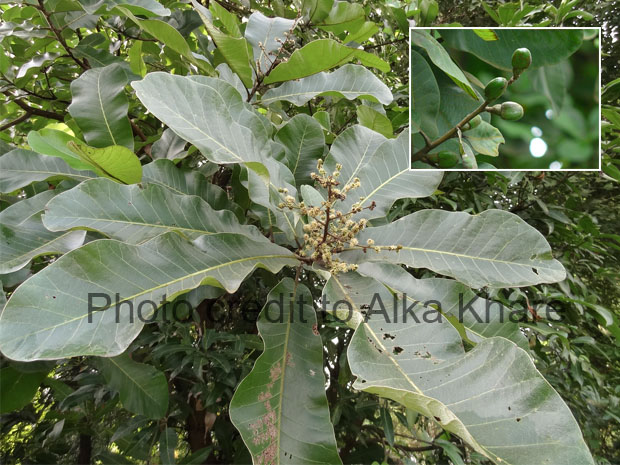
Char ചേര് / അലക്കുചേര്
Botanical name : Semecarpus anacardium Linn.f
PLANT NAME IN DIFFERENT LANGUAGES
English: Marking nut tree, Indian marking nut tree, Malacca bean
Malayalam: Alakkucher, Char
Sanskrit: Bhallataka, Arushkara
Hindi: Hhela, Bhilava
MEDICINAL PROPERTIES
Char is a moderate-sized deciduous tree with large stiff leaves. Leaves are 7-24 inches long, 2-12 inches wide, obovate-oblong, rounded a t the tip. Leaf base is rounded, heart-shaped or narrowed into the stalk, leathery in texture. Flowers is small, borne in panicles shorter than the leaves. Fruit is a drupe 1 inch long, ovoid or oblong, smooth and shining, black when ripe, seated on a fleshy cup. The stem yields, by tapping, an acrid, viscid juice from which a varnish is prepared. The nut yields a powerful and bitter substance used everywhere in India as a substitute for marking ink for clothes by washermen, hence it is frequently called Dhobi Nut. It gives a black colour to cotton fabrics, but before application it must be mixed with limewater as a fixator. The fruits are also used as a dye. They are also largely employed in Indian medicine. The fleshy cups on which the nuts rest and the kernels of the nuts are eaten.
In Toxicology the seeds of Marking nut tree is an important component of powerful ayurvedic antivenom for the treatment of patients who come in a critical condition due to snake bite.