
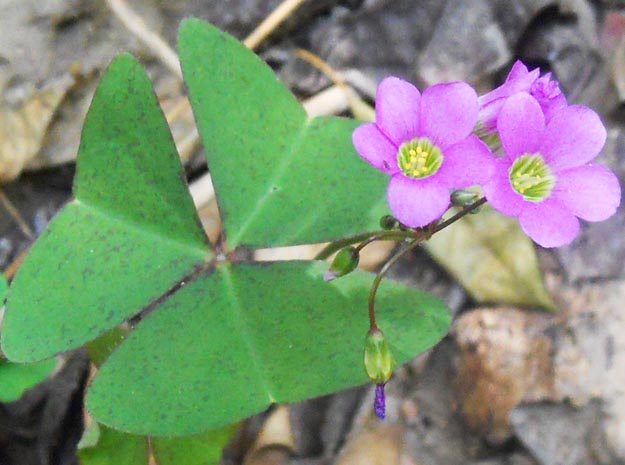
Chuvannapuliyaral ചുവന്നപുളിയാറില
Genus: Oxalis
Botanical name: Oxalis latifolia
PLANT NAME IN DIFFERENT LANGUAGES
Sanskrit: Raktachangeri, Amlapatri
Hindi: Tinapatiya, Amrulsak, Khatmitthi
English: Indian red sorrel, Wood sorrel, Violet wood-sorrel, Broadleaf woodsorrel, Mexican oxalis
Malayalam: Chuvanna puliyaral, Chuvanna puliyarila
MEDICINAL PROPERTIES
There are more than 800 species of woodsorrels or “shamrocks.” Most have clover-like leaves with three leaflets, sour tasting foliage (from the oxalic acid), and flowers and leaves that close up at night. Broadleaf woodsorrel has distinctly triangular leaflets, white or pinkish flowers with green throats, and grows from a thickened, bulblike taproot. It has no stems at all. Instead, the 8-10 in leaf petioles and flower pedicels arise directly from the rootstock. The leaflets are like equilateral triangles, about 2 in on a side and smooth bright green. The five-petaled, funnel-shaped flowers are about 1 in across and borne in loose, open clusters throughout the whole summer and fall. Broadleaf woodsorrel spreads readily from underground runners and forms a ground cover in moist, shady areas. Wood sorrels occur naturally on all continents.
The whole plant of Chuvanna puliyaral is used for urinary tract infections, cuts, scrapes, rashes, skin infections, digestive problems and kidney problems.
Indian red sorrel was used as a medicinal plant by Native Americans, including the Cherokee and Pawnee peoples.